








Every septic tank on a real project starts with the same question: how big does this actually need to be? Undersize it and the tank fills faster than it can treat waste, backing up plumbing and forcing frequent, expensive desludging. Oversize it by too much and you've paid for excavation, concrete and installation labour the site never needed. Getting the number right the first time matters, because a septic tank is not something anyone wants to dig up and replace.
The Two Numbers That Actually Drive Sizing
Septic tank capacity in India conventionally comes down to two inputs: the number of people the tank serves, the retention period, the number of days wastewater needs to sit in the tank for solids to settle and partially digest before the clearer effluent moves on to a soak pit or drainage field.
More usage means more daily flow, which means more tank volume is needed to hold that flow for the required retention period. A tank serving 5 people and a tank serving 50 aren't the same product scaled up proportionally either, since larger installations also need to account for peak simultaneous usage (a school at break time, a factory at shift change) rather than an even daily average.
Sizing by User Count: A Practical Starting Point
For independent homes and small residential sites, sizing is usually approached per person, using standard per-capita wastewater flow assumptions from Indian Standards combined with the retention period the code specifies. As a general shape, expect capacity requirements to scale with:
- Household size. A tank sized for a family of four looks meaningfully different from one sized for a joint family household of ten, even though both are "residential."
- Fixture count and usage pattern. A home with multiple bathrooms and a washing machine on the same line generates more flow than the same household size with fewer fixtures.
- Institutional peak load. Schools, hostels and factories need sizing based on peak occupancy and usage windows, not average daily headcount, since wastewater generation during a school day is concentrated into specific hours rather than spread evenly across 24.
For any project beyond a single independent home, working through the exact calculation with a design engineer is worth the time before a tank gets ordered. Getting this number from a generic online table rather than a calculation specific to the site's actual user pattern is one of the more common ways septic systems end up undersized.
Siting: Distance Rules That Protect Both the Tank and the Water Supply
Where a septic tank sits matters as much as how big it is. A few siting principles apply across residential, institutional and industrial installations:
- Distance from the building. A septic tank needs enough clearance from the building foundation to avoid structural interference and to allow future access for desludging, without sitting so far away that pipe runs become impractical.
- Distance from any borewell or drinking water source. This is a genuine health and safety requirement, not a formality. A septic tank sited too close to a borewell risks contaminating the groundwater the property actually drinks from, and most municipal codes specify a minimum separation for exactly this reason.
- Access for maintenance. A septic tank that's difficult to reach with a desludging vehicle tends not to get maintained on schedule, which shortens its effective service life regardless of how well it was built.
- Groundwater table depth. A high water table complicates both the tank's structural design and how well any downstream soak pit will perform, since percolation depends on the soil above the water table doing the work.
Precast vs Brick Septic Tank: Which Lasts Longer
A brick or RCC septic tank built on-site depends entirely on the mason's workmanship for watertightness. A joint that isn't sealed properly lets effluent seep into surrounding soil rather than moving through the tank as designed, which defeats the tank's purpose and creates a contamination risk at the same time.
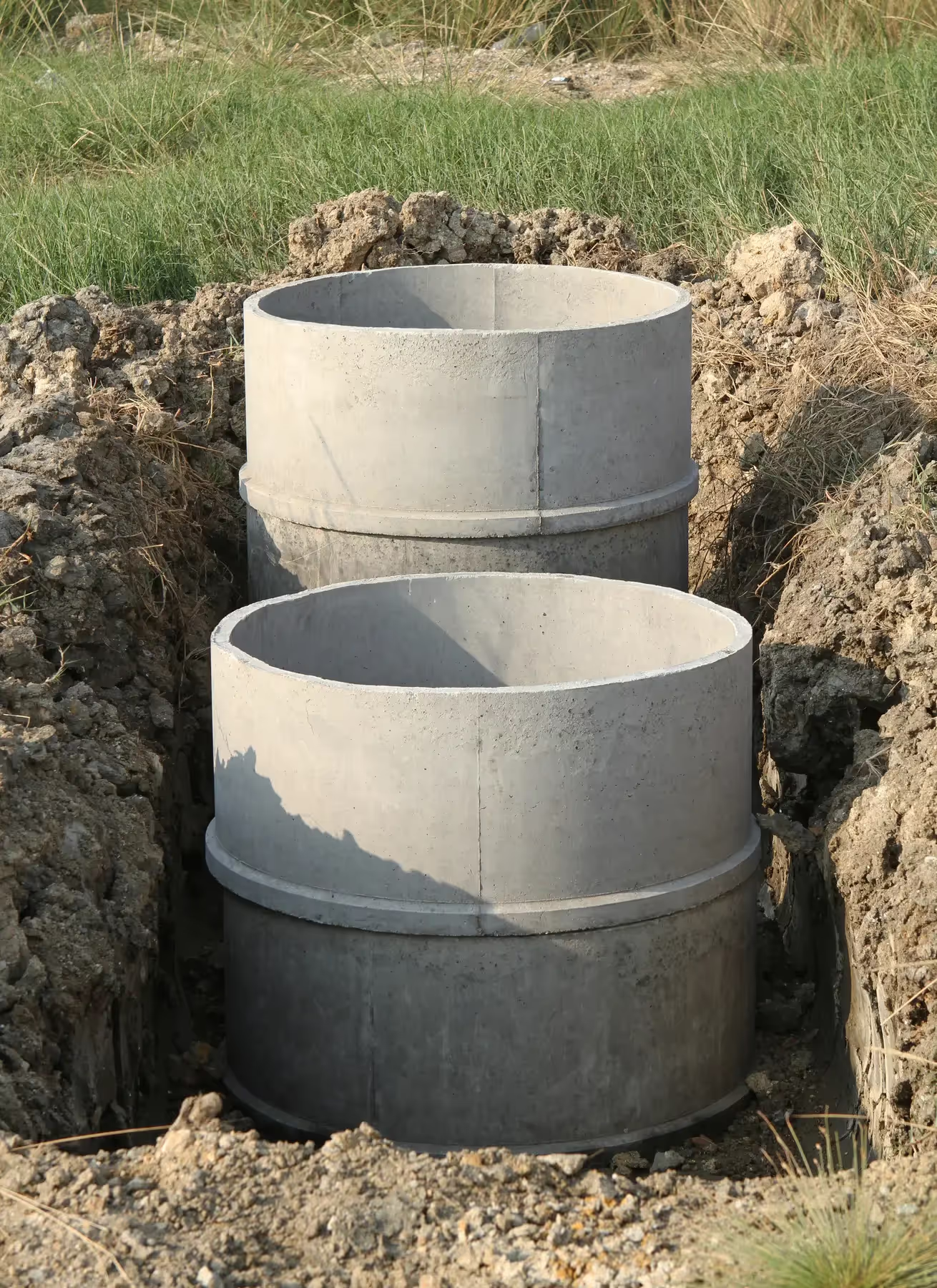
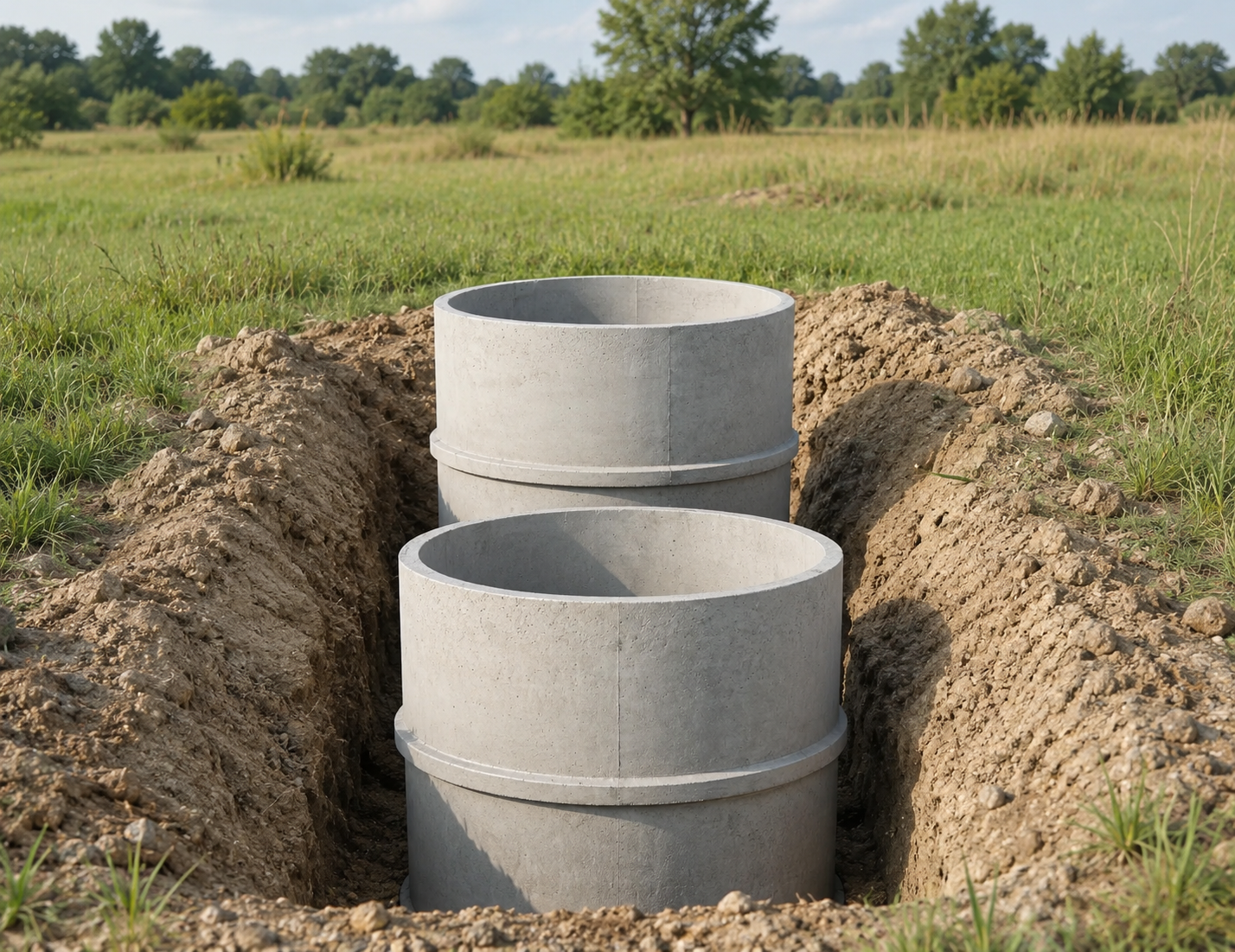
A precast septic tank is cast as a single watertight unit in factory conditions before it ever reaches site. Basant Betons' precast septic tanks are made with M40-grade concrete and reinforced with 550D steel rebar, manufactured under climate-controlled conditions specifically to achieve a fully watertight result rather than depending on on-site sealing. That factory consistency is also what allows the tank to maintain structural integrity under soil pressure and, where relevant, traffic loads above it, since the specification is fixed at manufacture rather than varying with site conditions on the day of the pour.
Installation is also considerably faster. A precast tank arrives ready to lower into an excavated pit, connect, and backfill, compared to the multi-stage process of building, curing and testing a cast-in-situ tank on-site. For institutional and industrial projects working to a fixed handover date, that installation speed is often as significant as the tank's long-term performance.
Applications Across Project Types
- Independent homes, apartments and villa projects. The most common application, typically sized per household with standard retention periods.
- Commercial and retail developments. Sizing shifts toward peak-hour usage patterns rather than a flat daily average, since footfall concentrates during business hours.
- Institutional facilities and campuses. Schools and hostels need capacity planned around occupancy peaks, not average daily headcount, and often benefit from a design engineer's involvement given the scale.
- Highway amenities and public utilities. These sites see highly variable, often unpredictable usage patterns, which makes conservative sizing and robust construction particularly important given the difficulty of retrofitting capacity later.
Common Sizing Mistakes and Edge Cases
- Sizing off a generic online table instead of actual usage. Plenty of quick-reference tables exist online for "septic tank size by number of users," and they're a reasonable starting point for a single independent home. They fall apart fast for anything with unusual usage patterns, a home office with client visits, a hostel with irregular occupancy, a factory with a canteen on-site, since these all add flow the generic table never accounted for.
- Retrofitting capacity after occupancy changes. A tank sized for a family of four that later becomes a joint household of ten, or a school that expands its student intake, often keeps running on the original tank simply because replacing it is disruptive. This is exactly the scenario where undersizing symptoms, frequent backups, more desludging than expected, show up years after the original installation, long after the sizing decision has been forgotten.
- Underestimating peak load at institutional sites. A school's wastewater generation isn't spread evenly across the day, it spikes hard around recess and dismissal. Sizing against average daily flow rather than peak concurrent usage is a common reason institutional septic systems back up during exactly the hours they're needed most.
Frequently Asked Questions
How do you calculate septic tank size by number of users?
Septic tank sizing under IS 2470 is based on the number of people using it, standard per-capita wastewater flow assumptions, and the code's specified retention period, the number of days wastewater needs to sit in the tank for solids to settle before the effluent moves on. Larger or institutional sites also need to account for peak simultaneous usage, not just average daily headcount.
Precast vs brick septic tank: which lasts longer?
Precast generally outperforms brick or cast-in-situ construction on watertightness, since a factory-cast unit doesn't depend on manual jointing to stay sealed. This directly affects service life, since seepage through poorly sealed brick joints is one of the leading causes of septic tank failure and contamination risk over time.
What happens if a septic tank is undersized?
An undersized tank fills faster than wastewater can be properly treated, leading to backups, more frequent desludging than the design intended, and reduced treatment quality in the effluent that reaches the soak pit or drainage field. It's a more expensive problem to fix after installation than to size correctly from the outset.
Does a septic tank need periodic maintenance regardless of size or construction quality?
Yes. Even a well-sized, well-built precast tank accumulates sludge over time and needs periodic desludging, typically every one to three years depending on usage, tank size and how well it was sized in the first place. Sizing and construction quality affect how often maintenance is needed, not whether it's needed.
Can septic tank capacity be customised for institutional or industrial sites?
Yes. Precast septic tanks are available in standard sizes and can be customised to specific capacity requirements, which matters for schools, factories and other sites where usage patterns don't match standard residential assumptions.
Is the Basant Betons precast septic tank compliant with Indian standards?
Yes, our Precast septic tanks of this type are manufactured in accordance with applicable IS standards governing septic tank design and construction, the same code framework used to calculate sizing in the first place.
Septic tank sizing gets easier to get right when it's calculated against your actual user count and usage pattern rather than a generic assumption. Browse our precast septic tank range, see the full chambers and tanks range, or write to us at enquiry@basantbetons.com with your site's occupancy details and we'll help you work through the calculation.